


Trimethylolpropane Production Process Package for Chemical Manufacturing
CAS No.: 77-99-6
The Trimethylolpropane Process Package is designed to optimize the production of trimethylolpropane, a versatile chemical used in the manufacture of resins, plasticizers, and lubricants. This package includes a complete process design, equipment specifications, and integration solutions to ensure efficient, scalable, and high-quality production.


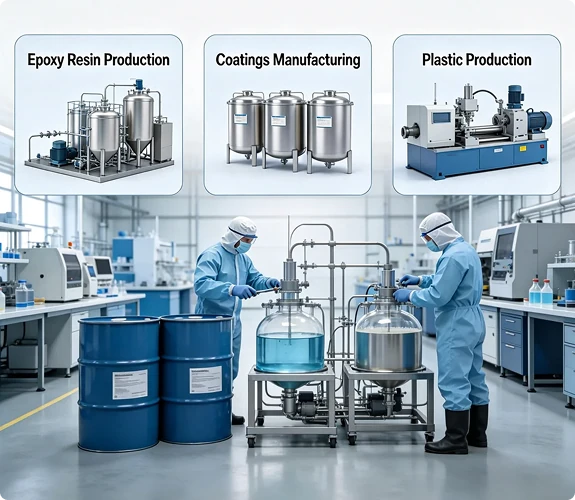
Trimethylolpropane Production Process Package Typical Usage
The Trimethylolpropane is typically used in industries producing alkyd resins, polyurethanes, and plasticizers.Our process package providing efficient and scalable solutions for high-quality product manufacturing.
- Used in the production of alkyd resins, enhancing durability and resistance in coatings.
- Applied in manufacturing plasticizers to improve flexibility and thermal stability in plastics.
- Essential in the production of polyurethanes, contributing to improved strength and versatility.
- Used in lubricants to enhance performance and reduce friction in machinery.
- Key ingredient in the production of adhesives, providing superior bonding strength and stability.
Trimethylolpropane Production Process
The Trimethylolpropane Production Process involves the condensation reaction of raw materials, followed by distillation, crystallization, and purification steps to ensure high yield, purity, and optimal performance in the final product.
Main Raw Materials for Pentaerythritol Production
N-Butyraldehyde
n-Butyraldehyde is the key feedstock for TMP production, undergoing aldol condensation with formaldehyde under alkaline conditions.
Formaldehyde
Formaldehyde provides carbonyl units for condensation reactions, enabling formation of intermediates in TMP synthesis.
Calcium Hydroxide
Calcium hydroxide acts as a solid alkaline medium in TMP production, promoting condensation, and enabling calcium formate formation.
Integrated Reaction Mechanism and Process Engineering
The reaction mechanism for trimethylolpropane production focuses on optimizing the interaction between n-Butyraldehyde and formaldehyde. This is achieved through carefully controlled condensation reactions, ensuring efficient conversion, high yields, and consistent product quality. Advanced process engineering techniques, including temperature and pressure control, further enhance the reaction’s efficiency, minimizing by-products and energy consumption while ensuring scalability for industrial applications.
Trimethylolpropane Production Process Package Core Advantage
The core advantage of the Pentaerythritol Production Process Package lies in its efficient design, optimized reaction conditions, and scalable processes, ensuring high yield, low energy consumption, and consistent product quality for diverse industrial applications.
High Yield and Efficiency
The Trimethylolpropane production process is designed to maximize yield while minimizing waste, optimizing reaction conditions to ensure high efficiency and cost-effectiveness in large-scale manufacturing.
Scalability
The process package is highly scalable, making it suitable for a wide range of production capacities, from small batches to large industrial volumes, ensuring flexibility and adaptability for different market demands.
Sustainability
With a focus on reducing environmental impact, the process incorporates energy-efficient technologies and sustainable practices, minimizing resource consumption and waste throughout production.
Cost-Effectiveness
By optimizing process parameters and reducing energy consumption, the Trimethylolpropane Production Process Package helps minimize operational costs, making it a cost-effective solution for manufacturers.
Trimethylolpropane Production Process Package Function
The Trimethylolpropane Production Process Package functions to streamline the entire production cycle, ensuring efficient chemical reactions, optimal yield, and consistent product quality while supporting scalable and cost-effective manufacturing processes.
Optimized Production Workflow
The Trimethylolpropane Production Process Package is designed to optimize every step of production, from raw material handling to final product output. It ensures efficient chemical reactions, consistent product quality, and high yields, while minimizing energy consumption and operational costs.
Trimethylolpropane Production Process Package Process Flow
The Trimethylolpropane Production Process Flow integrates condensation reaction, neutralization, evaporation, extraction, distillation, and flaking, with solvent recovery and by-product handling to ensure stable, efficient operation.
1
Condensation Reaction
Formaldehyde and n-butyraldehyde react in a controlled reactor to form TMP intermediates, ensuring stable conversion and selectivity.
2
Neutralization Step
The reaction mixture is neutralized to stabilize components and create suitable conditions for downstream processing.
3
Evaporation Stage
Water is removed through evaporation to concentrate the reaction solution and improve separation efficiency.
4
Extraction Process
Target TMP is separated from impurities using solvent extraction, enhancing product purity before refining.
5
Solvent Recovery
Extraction solvents are recovered and recycled, reducing consumption and improving overall process economy.
6
Distillation Purification
Distillation is applied to obtain high-purity TMP by removing residual impurities and light components.
7
Flaking Process
Purified TMP is cooled and formed into flakes, ensuring uniform product shape and ease of handling.
8
Packaging Stage
Finished TMP products are packaged to meet storage, transport, and commercial distribution requirements.
9
By-product Treatment
Calcium formate by-product is processed through concentration, centrifugation, and drying for reuse or sale.
Trimethylolpropane Production Process Package FAQ
Q1: What are the key advantages of the Trimethylolpropane Production Process Package?
The package ensures high yield, cost-effective production, scalable processes, and consistent product quality while minimizing energy consumption and waste.
Q2: How scalable is the Trimethylolpropane Production Process Package?
The process is highly scalable, adaptable for both small-scale and large industrial productions, allowing flexibility in meeting varying production demands.
Q3: What are the primary raw materials used in the production of Trimethylolpropane?
The main raw materials include propylene oxide and formaldehyde, which undergo a catalytic reaction to produce trimethylolpropane.
Q4: Which industries benefit from the Trimethylolpropane Production Process Package?
Industries such as coatings, adhesives, plasticizers, and lubricants benefit from the package, as trimethylolpropane is used in the production of resins, plastics, and various chemical formulations.


Start Your Chemical Engineering Project
Start Your Chemical Engineering Project
*We respect your confidentiality and all information is protected.